From Promises to Delivery: Professor Michel Kazatchkine on Accountability and Solidarity
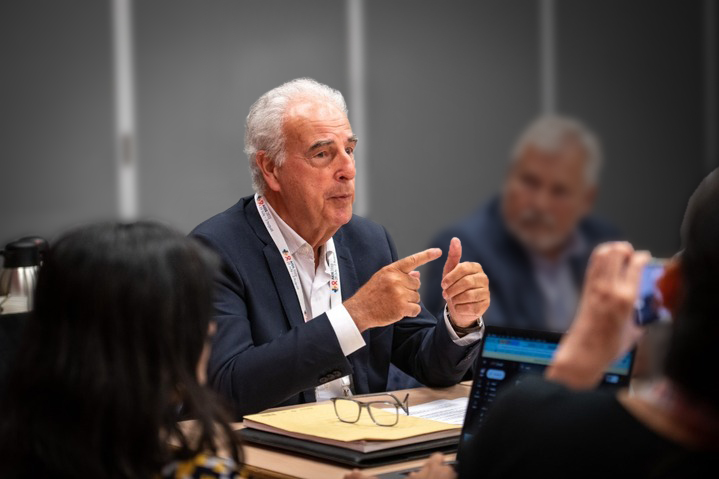
What follows a funding pledge — and how can we encourage its delivery while sustaining international cooperation? Speaking at a TOGETHER WE SAVE LIVES event alongside the World Health Summit 2026, Professor Michel Kazatchkine reflected on the political weight of financial commitments, the limits of enforcement and the shared work needed to keep solidarity alive.
On 13 October 2026, the TOGETHER WE SAVE LIVES campaign brought together political decision-makers, community advocates and Global Fund leadership in Berlin for a discussion on Political Leadership and Accountability in Global Health: From Promises to Delivery.
In his closing remarks, Professor Kazatchkine, former Executive Director of the Global Fund, drew on his experience to examine the uncertainties that follow financial pledges. He also challenged participants to consider how efforts to secure funding can strengthen cooperation around shared health goals.
From pledges to actual contributions
“Converting pledges into real contributions is a nightmare for the Executive Director of the Global Fund.”
Professor Kazatchkine opened with this candid observation, recalling the uncertainty that can follow replenishment announcements. He was describing the challenge of turning political commitments into funding that is actually transferred to the Global Fund over the three-year pledge period.
“I have seen pledges that have not turned to contributions. And I have seen, over a three-year period, some contributions actually exceeding the pledges. So you never know.”
His experience illustrates the distinction between an announced pledge and the resources ultimately received. For countries and communities, predictability matters: programmes need reliable funding to plan services, retain staff and maintain access to prevention and treatment.
The political weight of a pledge
Professor Kazatchkine then turned to the nature of a financial pledge. He emphasised that pledges are not legally binding and cannot be legally enforced. His focus was on the political credibility at stake when governments announce their intentions to contribute.
Governments make commitments to demonstrate their intentions, strengthen international relationships and build trust. Delivering on those commitments reinforces their standing. Failing to do so can weaken it.
“If they fail to deliver on pledges, this certainly diminishes their diplomatic leverage and their soft power.”
“It’s not about them and us”
Professor Kazatchkine also reflected on how accountability can strengthen cooperation around a shared goal: ending HIV, tuberculosis and malaria. He cautioned against an approach that places governments and civil society on opposing sides.
“I would like to caution everyone, it’s not about them and us. Let’s remember who is the enemy here.”
He continued:
“It’s not the government. It’s not the Global Fund director. It’s not the principal recipient, who also has to be accountable. It’s HIV and malaria and TB. And it is the wrong political choices that are made.”
His remarks raised an important question about how accountability is pursued: how can partners encourage the delivery of commitments while preserving the relationships and cooperation needed to sustain the response?
Different partners have different roles. Governments are to deliver on the funding they pledged. Civil society scrutinises commitments, brings community experience into decision-making and helps sustain public support for global health. The Global Fund and implementing partners turn resources into programmes and demonstrate their results. These roles depend on continued dialogue and a shared commitment to the people those programmes serve.
Professor Kazatchkine also challenged everyone involved — governments, civil society and international partners — to reflect on whether they had done enough to sustain public and political support for solidarity. His message was that this support cannot be taken for granted: it needs to be renewed and defended.
Keeping solidarity alive in uncertain times
Professor Kazatchkine placed these questions within a difficult political environment.
“We are in the context of mistrust. We are in the context of very fragile support to multilateralism. We are in budget contractions. And we are in the rise of populism.”
These pressures make the task more complex. Alongside efforts to secure contributions, there is a need to sustain the political and public support for international cooperation that makes those contributions possible.
“Ending AIDS requires really government, the civil society, the international organizations, the private sector to work together.”
Professor Kazatchkine’s reflections leave an important question for everyone working to sustain global health funding: how can we encourage the delivery of commitments while strengthening the solidarity and cooperation on which that funding depends? His contribution brings this question into the campaign’s wider discussion on political leadership and accountability.
As Professor Kazatchkine put it:
“We cannot abandon those core values of our movement.”